
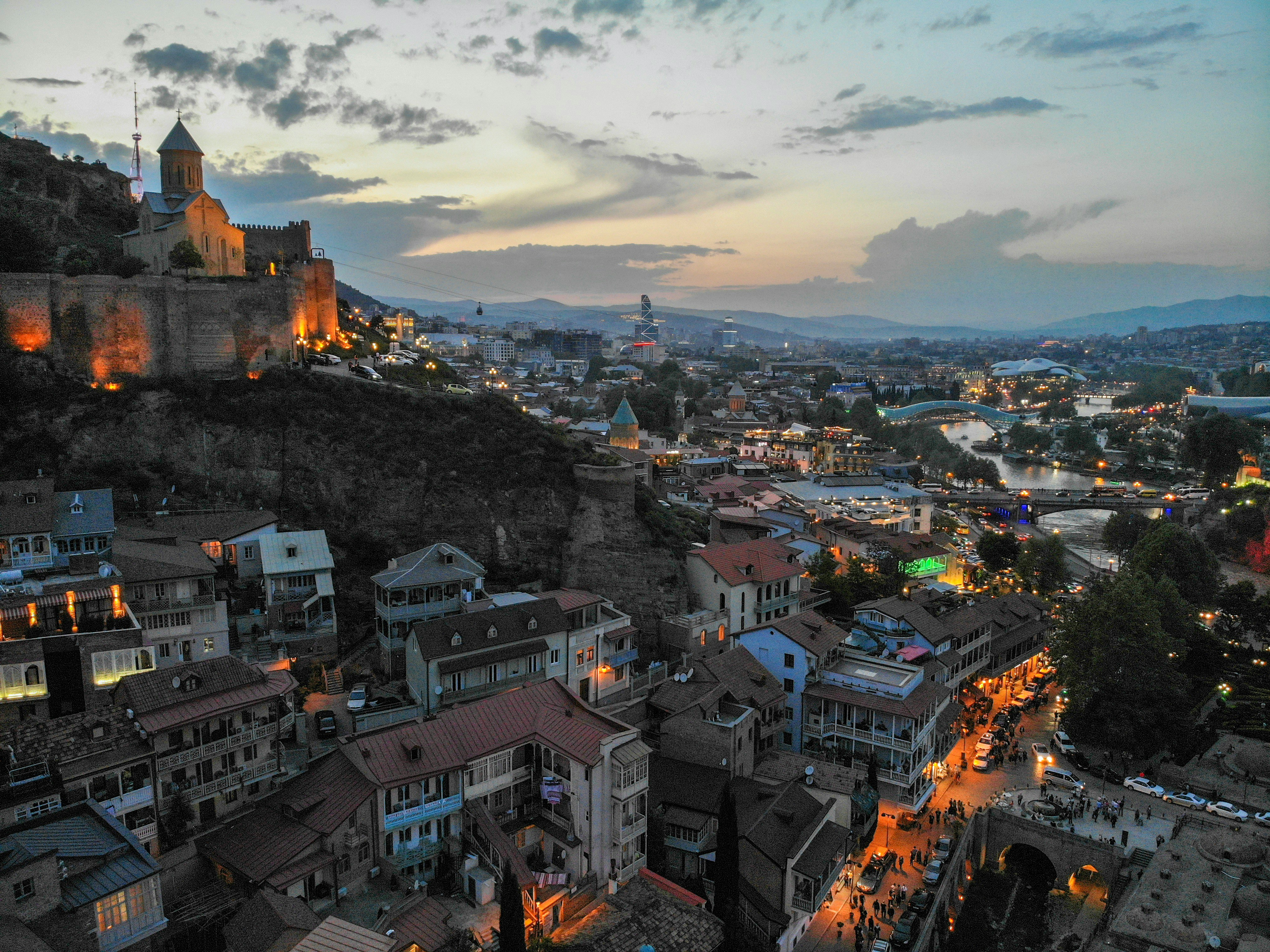
The International Baccalaureate (IB) is an extremely globalized program present in more than 146 countries and is studied by millions of students around the world. Georgia, despite being a minuscule country in Transcaucasia, managed to also implement this program in its schools. Despite its availability, financial or locational issues prevent students from taking it. Thus, a vast majority of Georgian students attend public schools wherein they study with the Georgian National Curriculum. This article will dissect the differences between the two programs and how the IB operates in Georgia.
Georgian IB Schools
Currently, there are four schools operating with the IB system in Georgia—all of which offer the DP program. However, the available DP subjects differ from school to school. For instance, the courses offered in my school are as follows:
| Subject Group | Available Subjects |
| Group 1 (Language and Literature) | English Language and Literature SL/HLGeorgian Literature SL/HLRussian Literature SL/HL |
| Group 2 (Language Acquisition) | English B HL French B SL/HLRussian B SL/HLSpanish B SL/HLSpanish Ab Initio SLItalian Ab Initio SL |
| Group 3 (Individuals and Societies) | Global Politics SL/HLHistory SL/HL Economics SL/HL |
| Group 4 (Experimental Sciences) | Chemistry SL/HLBiology SL/HLPhysics SL/HL |
| Group 5 (Mathematics) | Analysis and Approaches SL/HLApplications and Interpretation SL |
| Group 6 (The Arts) | Visual Arts SL/HL |
Similar to those taking the IB internationally, students studying in a Georgian IB school are required to choose six subjects. However, even though there are several options for the language groups, choices for other subjects are quite limited. If a student’s subject of interest is not available at their school, they have the option to complete the course online. This policy, however, also varies depending on the school.
All Georgian IB schools offer the integral parts of DP, including the EE, TOK, and CAS, which will be discussed further in the article. Furthermore, all four schools offer other programs alongside IB, including the Georgian National Curriculum and the American Program. An interesting observation is that international programs are largely taken up by foreign students rather than Georgians. This brings us to my next point: the IB is not widely adopted among Georgian students.
Lack of awareness about the IB in Georgia
An investigation conducted by Geostat states that approximately 89.9% of Georgian students attend public schools. This percentage alone tells us how massive and widespread the Georgian National Curriculum is compared to the IB in Georgia. Most of these students are unaware of the IB or other international programs, as there is barely any conversation about them in the country. Speaking from my own experience, my friends from public schools also weren’t aware of the IB. Why is it that less than 10% of Georgian students study in the IB program?
Firstly, private IB schools are quite pricey, some with fees above €10.000. Scholarship options are also limited, making them unavailable for the majority of Georgian students. In addition to being expensive, all Georgian IB schools are located in the capital city, Tbilisi, making them inaccessible for students living in other towns.
How is the IB different from the Georgian National Curriculum?
Levels and Certificates
Unlike the IB, where it is required for a student to continue their studies after MYP, the Georgian National Curriculum only mandates primary and basic education, from Grades 1 to 9. They issue a certificate after the completion of basic education, and upon receiving this certificate, students can either complete their studies or continue learning in a professional education program. Students with only a Basic Education Certificate cannot continue their studies at a university.
| IB | Georgian National Curriculum |
| PYP- Primary Years Program Grades 1-5 MYP- Middle Years Program Grades 6-10 MYP Completion Certificate issued. DP- Diploma ProgramGrades 11-12 IB Diploma issued. | Primary education Grades 1-6 Basic education Grades 7-9 Basic General Education Certificate issued. Secondary educationGrades 10-12 Full General Education Certificate issued. |
Subjects
Similar to the IB, before grades 11-12, students are required to take all the provided subjects. However, the MYP is more flexible than the national program as students are free to choose their subjects in groups such as Sciences. Similarly, DP students can also choose six subjects (see table #1). Conversely, Georgian students are required to continue learning all courses. Although the subjects may vary from school to school, the required courses are History, Geography, Georgian Literature, Foreign language, Biology, Chemistry, Physics, Math, and IT.
Service/CAS
CAS is an integral part of the DP program and is built to encourage students to participate in activities outside of their studies. This is extremely helpful for students as extracurricular activities are required for certain international universities. Georgian universities, however, do not require extracurriculars. Getting good grades on the National Exams and owning a Full General Education Certificate is enough to get a student accepted. So, the Georgian Curriculum does not contain an element similar to CAS.
IB Learner Profile
The IB has a set of attributes called the IB Learner Profile. These attributes aim to serve as the expectations that IB has set for its students. Students can also use them to determine what they can expect and strive to become after completing the program. Similar to the IB, the Georgian Curriculum also has a set of attributes that give insight into both the expectations of a Georgian student and the values around which the curriculum is built.
| IB | Georgian National Curriculum |
| 1. Inquirers 2. Knowledgeable 3. Thinkers 4. Communicators 5. Principled 6. Open-minded 7. Caring 8. Risk-takers 9. Balanced 10. Reflective | 1. Understanding the responsibility of the country’s interests, traditions and values. 2. Maintenance and protection of the environment. 3. Effective usage of technological or other intellectual achievements. 4. Living independently. 5. Creating values for themselves and not living at “the expense of existence”. 6. Continuously developing their capabilities throughout their lives and applying them both within and outside the country. 7. Effective communication with individuals and groups. 8. Being a law-abiding, tolerant citizen. |
Some similarities exist in the philosophy of both programs, such as encouraging critical thinking and independence in students. However, the IB focuses slightly more on global values than the Georgian Curriculum. If interested, you can see the IB attributes in detail on the Official IBO Website and the Georgian version on the Georgian National Center for Educational Quality Enhancement website.
Final Exams
In the IB DP program, students are required to complete exams in all six of their chosen subjects during the school year, either in May or November. These exams are known to be conducted in an extremely packed and exhausting schedule. They may play a noteworthy role in university acceptances as some universities use the IB predicted grades to see if a student is the right fit. The exams include three papers in all subjects and internal assessments, along with other factors determining the student’s final grade. The maximum grade is 45, and most reputable universities require a grade higher than 39.
In the Georgian Curriculum, the grades received during the school year are neither sent out nor paid attention to by universities. The Unified National Exams are the main factor that determine the student’s acceptance. These exams are conducted after the school year, usually in the first week of July. Unlike the IB, students have to choose the subjects they will be tested in. This is because students are only required to sit 3 exams even if they can take more than three courses. However, if a student requires an examination in an additional subject(s), they can choose up to six courses.
The first subject is Georgian Language and Literature, which is mandatory. However, students can choose the other two subjects. The second course is a foreign language. The available foreign languages are English, French, German, Russian, Armenian, Azerbaijani, Ossetian, and Abkhazian. The third subject can be either math or history, depending on the path the student is going to take. Students who want to major in STEM can be additionally examined in any science course. For instance, a student interested in medicine must take five subjects, with Biology and Chemistry as the added subjects. Geography, Fine and Applied Arts, General Skills, and Civic Education can also be additionally examined. Unlike the IB exams, the Unified National Exams are not conducted at the school where the student is studying. Each student is assigned a school in which they will write their exams. Multiple versions of each course exam are also assigned to the students.
Conclusion
To sum up, the Georgian National Curriculum is extremely different from the IB program due to differences in subjects, exams, school levels, and much more. However, they are both centered around shaping responsible, independent, and knowledgeable individuals who can apply their skills around the world. To learn more about the Georgian curriculum, feel free to check out the Georgian Ministry of Education website!
You may also like…
- Wiktoria’s views on IB in poland
- IBDP Teachers Interview: Mentors, Inspirations and Friends by Luca
