
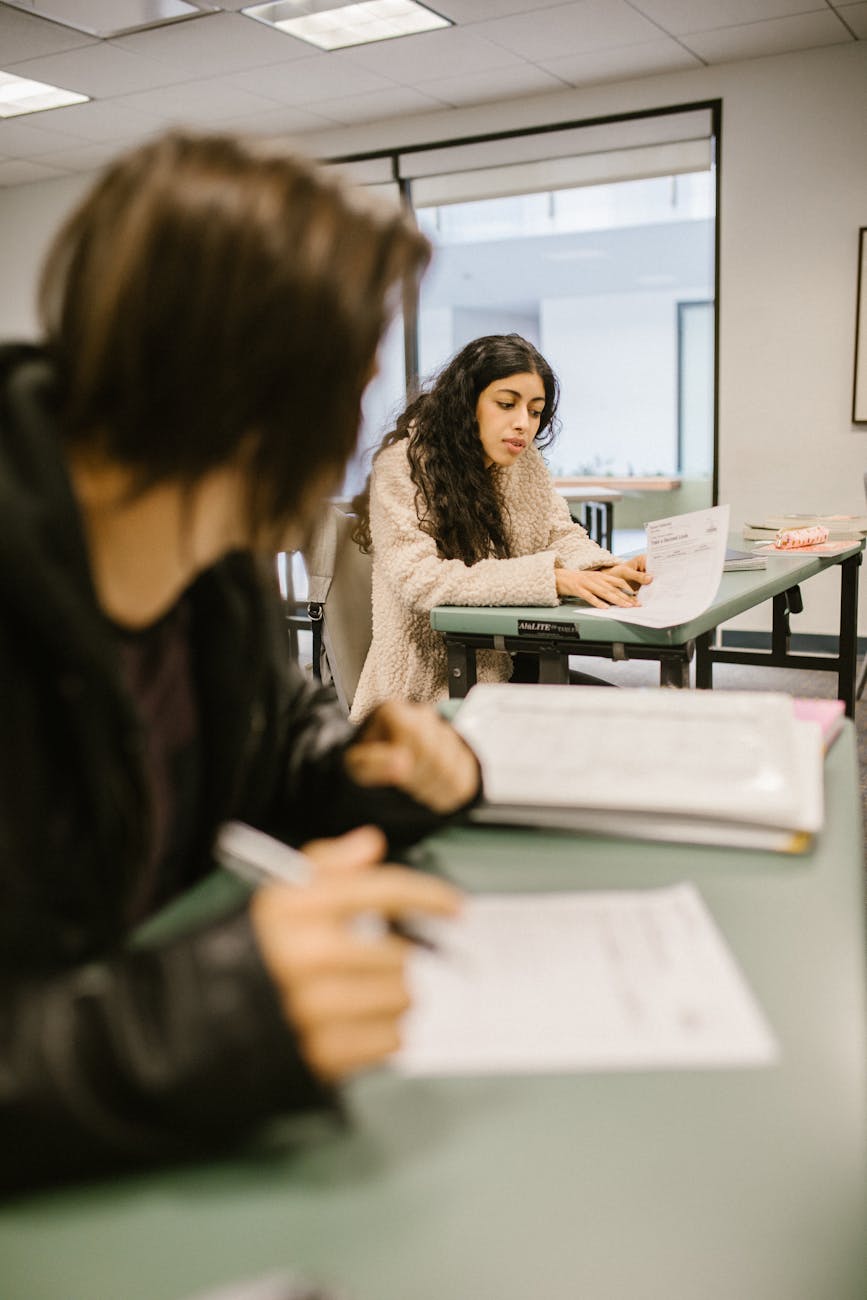
Mock exams can be stressful, however they are also an excellent opportunity for IB students to test their knowledge in exam-like conditions prior to their actual exams in May or November. To help students such as yourself through your mock exams, we interviewed an IB DP Graduate, Marie, who scored 41/42 points in her mocks. She shares her personal experience alongside techniques and advice that may help you prepare for your mocks.
Introduction
Starting with a short introduction, Marie shared a bit about herself and her IB journey.
“I went to an international school in Switzerland where I finished my IB Diploma in 2024. I took Math AI SL, Geography SL, and History SL. Then, I took English A HL, Biology HL, and German B HL.”
After graduating in May 2024, Marie took a gap year before heading to Sweden to study International Relations.
Question: How early did you start studying for your mock exams, and which techniques did you use to cover all the content?
“We had our mock exams after winter break, in January. I took a week off, then for the last 2 weeks of winter break, I studied every day.” Marie pointed out that for some subjects, her mock exams excluded Papers 2 and 3, as the content had not been fully covered. Generally, course content timelines vary across different schools, and students’ learning styles differ. Because of this, it is important to acknowledge that some students may need more time to prepare for their mock exams.
Regarding study techniques, Marie utilised varying techniques across her 6 subjects. “My study techniques depended on the subject. For Math, I printed out past papers. I would go over them and wherever I struggled and lost marks most, I further practiced similar questions on Revision Village. For Biology, I used a white board for active recall. I would condense all the information of one topic onto the whiteboard and write as much as I remembered. I also used lots of past papers and flashcards”
For History, Marie printed out graphic organizers that were provided in her class. These graphic organizers included timelines. “I remember I wrote down a timeline of important dates, and I rewrote that over and over to recall the key dates. I didn’t do example past paper writing because there wasn’t enough time.”
“For Geography, I had two notebooks with topics where I wrote all my in-class notes and case studies. I recited my notes to myself or rewrote things. I made posters and recited the posters out loud. I knew the essay and question structures so it was more a matter of knowing content than the structure.”
On a realistic note, Marie observed how she dedicated more time to some subjects than others. “Honestly, I sacrificed some subjects that I was better at, such as German. I focused more on subjects that I struggled with, including Math and Biology.” By the time of final exams, this had changed. “This was different for finals of course because I practiced past papers for English. For German, I listened to German podcasts.”
When reflecting back on her study timeline and preparation for her mock exams, Marie mentioned, “My mock exam experience made me more aware that I needed a more structured schedule. I had a loose schedule but I hadn’t planned it out. After the mocks were over, I wrote down all the topics that would be included in the finals and categorized them into what I was more proficient versus what I had to study in more depth.”
Question: Which study techniques did you use for your mocks that you ended up using for your final exams as well? Were there techniques you perhaps you didn’t use?
“I made the techniques I already used during my mocks more efficient. With Biology for example, I directed my attention to the flashcards and writing my answers on paper rather than a whiteboard. For English, I focused on writing more example papers and creating more graphic organizers for the themes and quotes. Most of my techniques stayed the same.” For History, she recalls having a memorization-focused approach to her studying. “The more I re-wrote things, the better I remembered it. I recited timelines, historical perspectives, and key facts.” For this question, Marie stressed the importance of repetition in general. Consistently repeating information, doing practice papers, and utilising such techniques helped her retain information and better prepare for her final exams in May.
Question: What did you struggle most with when preparing for mocks?
“Honestly, I was pretty satisfied because I knew I studied a good amount and I really tried my best. I wasn’t so concerned about mocks in general because I had covered most of what I set out to cover.” In relation to time management, Marie pointed out that mock exams were stressful, however she planned out her time to ensure she learned everything she needed to. To further expand on this, my next question for Marie was focused specifically on how she planned out her time in preparation for mock exams.
Question: What did you use to plan out your time?
“For planning, I didn’t do anything online because I prefer paper.” Marie shared how rather than pre – planning, “Every morning I scheduled my day and followed a school day routine of studying, taking breaks, etc. I wrote down 4 or 5 categories that I wanted to study during the day.”
By categories, Marie referred to specific topics she aimed to cover during that day. For example, this could be specific civil wars or authoritarian leaders for History, or more difficult HL topics for Biology. Marie ensured that everyday, “They would always be different subjects so I wouldn’t get bored. The order in which I studied them was up to me.”
Students may prefer planning on paper, while others favor digital to-do Lists. For Marie, she hadn’t pre-planned as much, but on a daily basis she clearly outlined her targeted learning goals, which helped her plan out her time.
On another note, Marie highlighted that for both mock exams and final exams, “I didn’t study late, I got good sleep every day”. With a rested mind she was able to productively prepare for exams and confidently write them, without being burnt out or exhausted.
Question: What were the main resources utilized to help you study?
“For Math, I used Revision Village. It made a big difference because it had video segments that would explain in steps, how you got to the answer. For Biology, I used flashcards from Smartprep. Because I didn’t have HL flashcards, I would use Revision Dojo for practice questions. Then, for long answer questions I’d create flashcards myself with the answers on the back. For Geography, I also used Revision Dojo, but more so my notes and website that our teacher had made. For both History and English I made graphic organizers. For English specifically, I did past papers using questions that my teachers uploaded. Then, as a native German speaker, I mainly focused on writing in German or listening to German videos or German podcasts that would put me in a ‘German headspace’.”
Question: To summarize, what is your key takeaway from your IB mock exam experience? What is your main advice for IB students preparing for their mock exams?
“My key takeaway is that mock exams are a time to figure out what study method works for you. If you realize something is not efficient, don’t keep doing it. Maybe ask your friends what they did and try new techniques. Also, use mock exams as a practice experience. If you truly study for your mock exams, you’ve already got a headstart for your final exams and you don’t have to start from scratch.”
As an additional tip, our interview ended with Marie saying, “If some people have issues with phone addiction and getting distracted, video yourself and make a timelapse. If you have a sibling, give it to your sibling or parent. I would also give myself breaks. Getting to sleep on time was pretty useful. I never felt exhausted. I was tired, but not sleep deprived. Lastly, going outside was important for me as well. Everything I say might sound cliche, but once I got my routine down it was very useful.”
Conclusion
Overall, we hope that Marie’s interview has shed some light on ways you can prepare for your IB mock exams, and do the best you can! If you’re ever stuck, you can think back to Marie’s advice and remember to prioritize repetition when studying. Remember to prioritize sleep to avoid exhaustion and burnout. After your mocks, take a moment to reflect back on your study techniques and time management, just as Marie did, to then consider the most productive way to approach your final exams. Good luck!
